


Table of Contents
- Integrated Cabling vs. Point-to-Point: The Real Cost Difference
- NDAA-Compliant Cabling Standards and Compliance Costs
- How Integrated Cabling Simplifies Moves, Adds, and Changes
- Scalability, IoT Integration, and Future-Proofing Your Infrastructure
- An ROI Framework for Integrated Cabling Decisions
- Conclusion
- Frequently Asked Questions
Last Updated: October 2, 2026
Integrated Cabling vs. Point-to-Point: The Real Cost Difference
Integrated cabling is a unified network infrastructure approach that consolidates voice, data, security, and building systems onto a single structured backbone, rather than running separate point-to-point connections for each device or service. The cost difference shows up less in the initial invoice and more in everything that follows: maintenance, downtime, and the labor required every time your building changes. This guide from Elite Connect LLC breaks down where the money actually goes, and why the cheapest bid at installation is rarely the cheapest decision over a system's lifecycle.
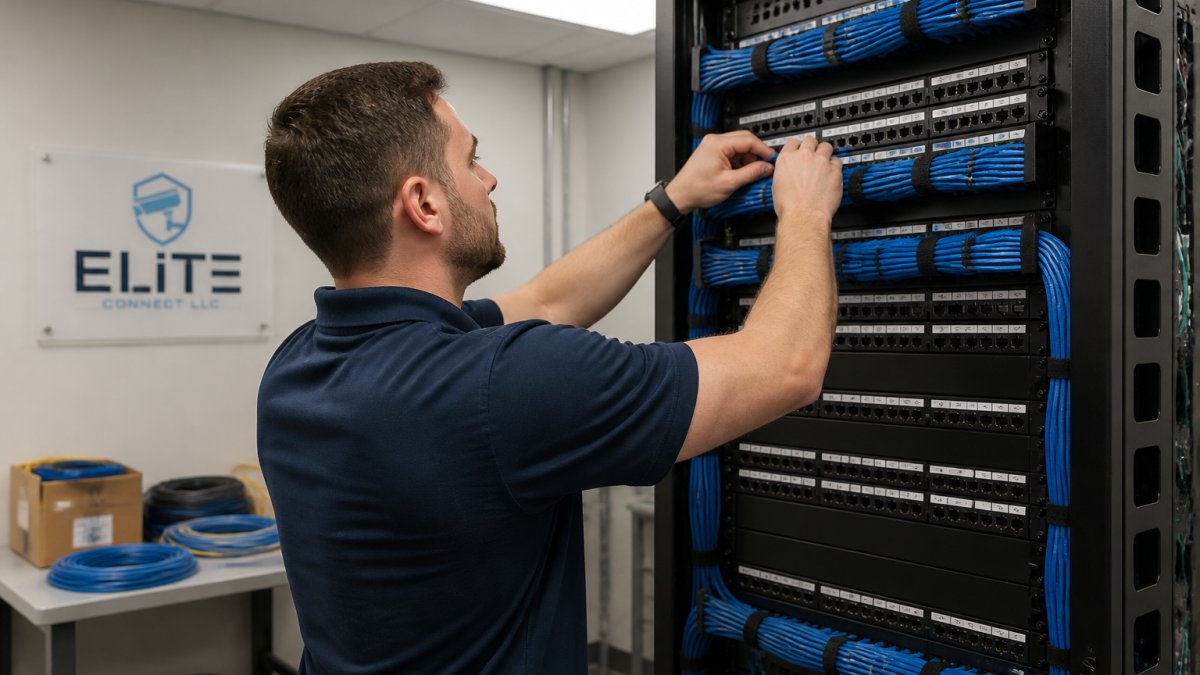
Point-to-point wiring looks cheaper on day one. Each camera, access reader, or wireless access point gets its own dedicated run back to a switch or recorder.
(/services/security-cameras/), access control, or tenant internet go offline, you're dealing with lost productivity, security gaps, and in commercial settings, potential liability. The [Uptime Institute's annual outage analysis](https://uptimeinstitute.com/resources/research-and-reports/annual-outage-analysis-2025) has consistently found that downtime costs escalate sharply with duration, and that many organizations underestimate their true cost per hour.Most guides stop there. The useful question is what actually drives the cost of an outage, because that is where integrated cabling changes the math. Downtime cost is a function of four variables:
- Time to detect, how long before anyone notices a device or segment is down
- Time to isolate, how long it takes to find the physical fault
- Time to repair, how long the fix itself takes once located
- Blast radius, how many devices, tenants, or systems go down with the fault
Point-to-point wiring inflates every one of those variables. A single unlabeled home run can take hours to trace, and because each device sits on its own isolated run, the technician has no shared reference point to work from. Integrated cabling compresses them: labeled patch panels shorten detection and isolation, standardized terminations shorten repair, and a documented backbone limits how far a single fault propagates.
Business Continuity and Risk Mitigation
Business continuity planning treats the physical layer as critical infrastructure, not an afterthought. A structured cabling system with documented redundancy and clear labeling supports faster recovery after an incident, whether that's a failed switch, a cut cable, or a power event.
The risk mitigation value is real but hard to quantify until something goes wrong. A practical way to frame it for ownership is to estimate the cost of a single worst-case outage, a full day of lost tenant connectivity, a security system offline overnight, or a failed inspection that delays a certificate of occupancy, and then ask how much faster a documented system would restore service.
Downtime cost is driven by detection, isolation, repair, and blast radius, not by the repair invoice. Integrated cabling attacks all four at once, which is why the savings show up in the outage you never had to fully pay for.
NDAA-Compliant Cabling Standards and Compliance Costs
NDAA-compliant cabling standards refer to equipment and components that meet the sourcing restrictions under Section 889 of the John S. McCain National Defense Authorization Act, which prohibits federal agencies and their contractors from using covered telecommunications and video surveillance equipment from specified manufacturers. For government projects and federally funded work, non-compliant equipment can disqualify an entire installation.
Compliance costs money upfront because compliant equipment and documented sourcing carry a premium over unverified alternatives. The cost of non-compliance is worse: failed inspections, forced replacement, and in some cases, loss of contract eligibility. The FCC's covered equipment list is the authoritative reference for which manufacturers are restricted.
For procurement officers, the practical requirement is documentation. Every component needs a traceable source, and the installation needs test results and as-builts that prove what was actually installed. Elite Connect LLC builds this documentation into every project, which is why government and commercial clients use us for NDAA-compliant electronic security and IT installations.
How Integrated Cabling Simplifies Moves, Adds, and Changes
Moves, adds, and changes, often shortened to MACs, are the recurring modifications every building needs: a new tenant, a relocated camera, an added access reader, a new wireless access point.
The cost difference compounds over time, and it is worth modeling rather than asserting. A simple MAC cost model has four inputs:
- Annual MAC volume, how many changes your property actually averages per year
- Labor hours per change, higher on point-to-point because each change includes a new run, penetration, and termination
- Material per change, cable, jacks, faceplates, and firestop on point-to-point; often just a patch cord on integrated
- Disruption cost, tenant downtime, after-hours scheduling, and ceiling or wall access
Run that model across a ten-year horizon and the pattern is consistent: the integrated system's higher installation premium is recovered through avoided MAC labor and material, and the gap widens every year the building stays in service.
- New tenant fit-out: patch into existing backbone instead of running new home runs
- Camera relocation: re-terminate at the nearest available port
- Access control expansion: add readers to the existing structured system
- Wireless coverage gaps: add access points without new cabling to the IDF
Why Documentation Is the Real MAC Multiplier
The MAC savings depend on one thing most bids ignore: documentation. An integrated system without as-builts and test results behaves like point-to-point during a MAC, because the technician still has to trace what exists.
This is why the MAC argument and the documentation argument are the same argument. When you compare bids, ask what documentation is included and who owns it after turnover.
Before signing off on any low-voltage project, confirm you will receive labeled patch panels, as-built drawings, and test results at turnover. Those three deliverables are what convert an integrated install into recurring MAC savings.
Scalability, IoT Integration, and Future-Proofing Your Infrastructure
Scalability in cabling means the installed backbone can support more devices, higher bandwidth, and new categories of connected systems without a full rewire. This is where integrated cabling separates itself from point-to-point most clearly: the TIA-568 cabling standards define performance categories that determine what a cable plant can support as bandwidth demands grow.
IoT and smart building systems, from environmental sensors to smart lighting and building automation, all need the same thing: reliable connectivity with documented performance. A structured backbone with fiber optics and category-rated copper can absorb these systems as they're added. A point-to-point install usually can't, which means a costly retrofit later. Fiber in particular future-proofs the network backbone for bandwidth that copper alone can't deliver over long runs.
The test of a cabling system isn't how it performs on day one. It's how well it absorbs the devices, tenants, and bandwidth demands you haven't added yet.
An ROI Framework for Integrated Cabling Decisions
An ROI framework for integrated cabling compares the upfront premium against the avoided costs of downtime, MAC labor, and premature replacement over the system's expected life. Most guides skip this math entirely and just list qualitative benefits.
| Cost Category | What to Measure | Why It Matters |
|---|---|---|
| Installation premium | Integrated bid minus point-to-point bid | The number you must justify |
| MAC labor | Annual changes × labor hours per change | Compounds every year |
| Downtime exposure | Hours of outage × cost per hour | Often the largest hidden cost |
| Troubleshooting time | Service calls × hours per call | Shrinks with documentation |
| Replacement avoidance | Years added before rewire | Structured systems outlast point-to-point |
Run the numbers over a realistic system lifecycle, not a single budget year. The installation premium is a one-time cost. The savings recur every year the system is in service.
Conclusion
The hardest part of justifying integrated cabling isn't the technical case, it's getting ownership to look past the initial line item and see the recurring costs that follow a cheaper install. Elite Connect LLC handles that conversation with itemized proposals that specify cable type, category, and rating, so you can compare bids on equal footing instead of guessing what's included.
Frequently Asked Questions
Is structured cabling worth the investment for a small business?
For small businesses, structured cabling often pays off faster than owners expect because it removes the recurring cost of ad-hoc fixes. A standardized layout with labeled patch panels means any technician can troubleshoot in minutes instead of hours. It also supports future expansion without a full rewire. Elite Connect LLC handles projects of all sizes, including small offices, and provides itemized proposals so you can see exactly what you are paying for before committing.
What are the primary disadvantages of traditional point-to-point cabling?
Point-to-point cabling creates a separate run for every device, which leads to cable sprawl, undocumented connections, and higher installation labor over time. Moves, adds, and changes require new runs rather than simple patch panel updates. Troubleshooting becomes guesswork without labeling or test results. The result is higher maintenance overhead, more downtime risk, and a network that becomes harder to manage with each addition. Integrated cabling replaces that pattern with a documented, standardized backbone.
How does NDAA-compliant cabling impact project longevity and compliance costs?
NDAA Section 889 restricts federal agencies and their contractors from using certain covered telecommunications equipment. Specifying NDAA-compliant cabling standards from the start avoids the cost of ripping out non-compliant hardware later. For government projects, non-compliance can mean failed inspections, delayed payments, or full replacement. Elite Connect LLC uses only NDAA-compliant equipment and provides test results and as-builts to document compliance, which reduces audit risk and protects the infrastructure investment over its full lifecycle.
How does integrated cabling improve network scalability?
A structured cabling backbone with high-density patch panels and fiber optics lets you add devices, access points, or cameras by patching into existing ports rather than running new cable. That cuts the labor cost of every expansion. It also supports higher bandwidth as your needs grow, whether you are adding IoT sensors or upgrading to faster switches. Elite Connect LLC designs the backbone with spare capacity so future growth does not require a full rewire.
