
Quick Summary
Low voltage wiring code requirements are set mainly by NEC Articles 725 and 722, which classify circuits by power source and hazard level rather than a single voltage number. Installers must match cable class and listing to the environment, keep low voltage and line voltage conductors separated, and seal fire-rated penetrations.
- Anything under 50 volts is not automatically low voltage; classification depends on power source and energy delivered.
- Conduit is a protection decision: concealed listed cable often needs none, while exposed runs usually need approved raceway.
- Low voltage and line voltage conductors generally cannot share a raceway, cable, or box without a listed assembly or barrier.
- Every fire-rated penetration needs a listed firestop system, with records kept for the inspector.
- Plenum spaces require plenum-rated cable, so always confirm the cable marking before installing it.
Table of Contents
- What Counts as Low Voltage Wiring Under the NEC
- How NEC Articles 725 and 722 Govern Low Voltage Cable
- NEC Conduit Requirements for Low-Voltage Cable
- Low-Voltage and High-Voltage Wiring in the Same Conduit
- Low-Voltage Cable Through Walls Code and Firestopping
- Plenum-Rated Low-Voltage Cable Requirements
- Booking a Code-Compliant Low Voltage Installation in Virginia
- Frequently Asked Questions
7 Low Voltage Wiring Code Rules Every Installer Must Know
Last Updated: November 1, 2026
What Counts as Low Voltage Wiring Under the NEC
Low voltage wiring is the cable that powers and connects security cameras, alarms, doorbells, thermostats, and networks. Installing this kind of wiring starts with knowing which circuits the National Electrical Code (NEC) actually covers. Low voltage wiring carries power at levels that are generally considered low enough to pose less shock risk than line voltage.
The NEC does not use a single number for every case. Instead, it classifies circuits by their power source and hazard level. Power-limited circuits fall under NFPA 70 National Electrical Code, which sets the rules that installers and inspectors follow.
Many installers assume that anything under 50 volts is automatically low voltage. That shortcut often leads to trouble. The classification depends on how the circuit is powered and how much energy it can deliver, not just the voltage reading.
- Doorbell and thermostat circuits usually run at 12 to 24 volts
- Security and alarm wiring is typically power-limited
- Network and data cabling carries signals, not significant power
How NEC Articles 725 and 722 Govern Low Voltage Cable
Two parts of the NEC control most low voltage cable work. Article 725 covers Class 1, Class 2, and Class 3 remote-control, signaling, and power-limited circuits. Article 722 covers cable for communications and power-limited circuits that are not covered elsewhere.
Article 725 is the one most installers reference first. It sets the rules for how cable is classified and separated from power wiring. Article 722 adds requirements for communications cable, including the cable types that can be used in specific spaces.
Here is a quick summary of what each article typically controls:
| Article | Covers | Common Use |
|---|---|---|
| 725 | Class 1, 2, 3 circuits | Alarms, doorbells, control wiring |
| 722 | Communications cable | Data, voice, and network runs |
Watch out: Both articles can apply to the same job. Check each one before you pull cable.
NEC Conduit Requirements for Low-Voltage Cable
Conduit is not automatically required for low voltage cable, but the NEC does set conditions where protection is mandatory. The rule is driven by three variables: the cable's class and listing, the environment the cable passes through, and whether the cable is exposed to physical damage. Get those three right and the conduit question usually answers itself.
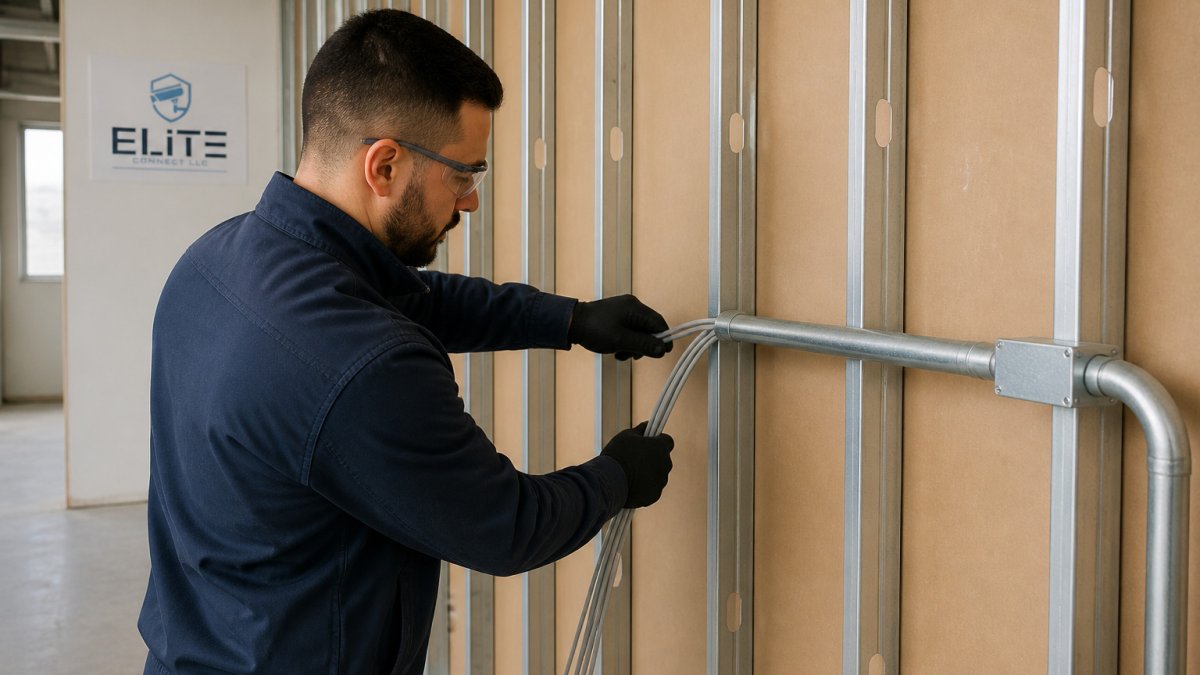
The starting point is Article 725. Class 2 and Class 3 circuits are governed by 725.135 and the accompanying installation requirements in Part III, which permit open wiring methods where the cable is listed for the application and is not subject to physical damage. Class 1 circuits are treated more like line-voltage wiring and carry stricter routing and protection rules. Communications cable under Article 722 follows a similar logic through its own installation articles. In practical terms, a CL2 or CL3 listed cable run through open stud bays in a protected interior wall generally does not need conduit; the same cable run across an exposed basement ceiling, along a garage wall, or through a floor where it can be stepped on or struck usually does.
Use this decision sequence before you pull cable:
- Identify the circuit class. Confirm whether the run is Class 1, Class 2, Class 3, or communications. The class determines which installation article applies.
- Check the cable listing. The jacket marking (CL2, CL3, CMR, CMP, CM, or a communications equivalent) tells you where the cable is permitted. A cable not listed for the environment cannot be made compliant by adding conduit alone.
- Assess exposure. Is the run concealed inside finished framing, or exposed where it can be damaged? Exposed runs in garages, crawlspaces, attics with foot traffic, and mechanical rooms are the usual triggers for raceway or other approved protection.
- Confirm the raceway type. Where protection is required, use a raceway or conduit recognized by the NEC for the location, EMT, PVC, or flexible raceway depending on the environment, and size it for the cable bundle.
- Verify local amendments. Many jurisdictions add requirements beyond the model code, especially for exposed runs in commercial spaces. Confirm with your authority having jurisdiction (AHJ) before assuming open cable is acceptable.
A common pattern in inspection failures is a cable that is correctly rated but run exposed across a mechanical room or attached garage without protection. The fix is usually a short raceway sleeve or a reroute, cheap if caught before drywall, expensive after.
- Concealed interior wall runs: open cable is typically acceptable when the cable is listed for the location
- Exposed runs subject to damage: raceway or other approved protection is typically required
- Plenum and riser spaces: the space rating (CMP or CMR) controls, not the conduit
- Underground or direct-burial runs: use cable listed for direct burial or a raceway approved for the location
Low-Voltage and High-Voltage Wiring in the Same Conduit
Mixing low voltage and line voltage conductors in the same raceway, box, or cable assembly is one of the most frequently cited violations on low voltage jobs. The NEC restricts the practice for two reasons: line voltage can induce noise or fault current onto low voltage circuits, and a shared raceway creates a path for line voltage to reach equipment a technician or homeowner might touch.
The controlling rules sit in Article 725 and Article 300. Section 725.136 establishes the general separation requirement: Class 2 and Class 3 circuit conductors generally cannot be placed in the same raceway, cable, or box with conductors of electric light, power, Class 1, or non-power-limited fire alarm circuits. Article 300.3(C) similarly limits conductors of different systems in the same raceway unless the systems are insulated for the maximum voltage present and the arrangement is approved. Article 722 carries parallel separation language for communications circuits.
The exceptions matter, and they are where most of the confusion lives:
- Listed composite cable assemblies. Some listed cables combine power and low voltage conductors in a single jacket with factory separation. These are permitted where the listing allows and the assembly is used as intended.
- Class 2 or Class 3 circuits in a raceway with power conductors. Permitted only where the low voltage conductors are separated by a barrier, are installed in a listed raceway or box with a permanent barrier, or the power conductors are part of a listed assembly that maintains separation.
- Class 1 circuits. Treated more like power wiring; the separation rules are stricter and the exceptions narrower.
- Barriers and dividers. Where a shared box or raceway is used, a listed barrier or divider must maintain physical separation between the systems.
A practical separation checklist before you pull cable:
- Confirm the circuit class of the low voltage run (Class 1, Class 2, Class 3, or communications).
- Determine whether the shared raceway or box is a listed assembly with factory separation, or a field-built arrangement that needs a barrier.
- Verify the insulation rating of every conductor against the maximum voltage present in the shared space.
- Check the AHJ for local amendments, some jurisdictions prohibit shared raceways entirely regardless of the NEC exceptions.
- Document the separation method on the as-built so the inspector can verify it.
Low-Voltage Cable Through Walls Code and Firestopping
When low voltage cable passes through a fire-rated wall or floor, the penetration must be sealed with an approved firestop system. This rule protects the building's fire separation, and inspectors check it closely.
Each penetration should be sealed with a system tested for that wall assembly. Using the wrong sealant or leaving gaps around cable bundles can fail inspection. Document each firestop you install so the inspector can verify it.
Cable must also be secured and protected where it passes through framing. Sharp edges can cut the jacket and expose conductors over time.
- Use a listed firestop system for every fire-rated penetration
- Keep records of firestop types and locations
- Protect cable from sharp framing edges
Watch out: A cable that passes through a fire-rated wall without a firestop can fail inspection even if the wiring itself is perfect.
Plenum-Rated Low-Voltage Cable Requirements
Plenum spaces are areas used for air circulation, such as above drop ceilings or within air ducts. The NEC requires plenum-rated cable in these spaces because standard cable jackets can release toxic smoke when they burn.
Plenum-rated cable is marked with a designation that shows it has passed fire and smoke tests. Using non-plenum cable in a plenum space is a serious violation. Always confirm the cable marking before you install it.
Riser-rated cable is used in vertical shafts between floors. General-purpose cable is typically limited to spaces that are not plenum or riser areas. Matching the cable rating to the space is one of the simplest ways to pass inspection.
Booking a Code-Compliant Low Voltage Installation in Virginia
Code compliance is easier when a licensed contractor handles the whole job. Elite Connect LLC is a Virginia-based, owner-led contractor that integrates low-voltage and electronic security work under a single point of accountability. We provide itemized proposals and comprehensive documentation, including test results and as-builts, so you can verify the work.
If you are planning a project, a consult and proposal is the fastest way to confirm what your job needs before work starts.
Contact Elite Connect LLC for a consult and proposal to review your low voltage project.
Frequently Asked Questions
What is considered low-voltage wiring?
Low-voltage wiring generally refers to circuits operating at 50 volts or less under the National Electrical Code, including doorbell, thermostat, security, network, and control circuits. The NEC classifies these under Article 725 for Class 1, 2, and 3 remote-control, signaling, and power-limited circuits, and Article 800 for communications. Because classification depends on the circuit's power source and its limits, the specific wiring method and cable type should be confirmed against your local code and the authority having jurisdiction before installation.
Can low-voltage and high-voltage wiring run in the same conduit?
Generally, the NEC restricts mixing power-limited low-voltage conductors with line-voltage conductors in the same raceway unless the code specifically permits it, such as when the low-voltage conductors are separated by a barrier or are the same classification. Separation requirements vary by circuit class and edition of the code. Verify the current NEC article for your circuit type and check with your local authority having jurisdiction, since local amendments can be stricter.
Do low-voltage cables need to be plenum-rated?
Cables installed in air-handling spaces such as plenums, return-air ducts, and similar areas generally must carry a plenum rating, typically designated CMP, under NEC requirements for communications and power-limited cables. Riser-rated (CMR) cable is used in vertical shafts between floors, and general-purpose (CM) cable is used in other locations. Confirm the cable's UL listing and marking match the installation environment before pulling wire.
Does low-voltage wiring need to be inspected?
Many jurisdictions require permits and inspections for low-voltage installations, especially for fire alarm, life safety, and access control systems in commercial buildings. Requirements depend on the scope of work and local adoption of the NEC. Before starting, contact your local building or electrical inspection office to confirm permit thresholds, and plan for inspection of firestopping and penetrations where cable passes through rated assemblies.