
Last Updated: October 25, 2026
Quick Summary
Integrated IT and security services combine technology infrastructure, cybersecurity, physical security systems, and operational management under a single coordinated approach, connecting network security, access control, video surveillance, and IT operations so they work as one unified platform rather than as separate functions managed by different vendors.
- The U.S. security services industry reached $51.5 billion in 2026, reflecting demand for integrated approaches.
- Integration requires five architectural layers: network segmentation, identity provider federation, event pipeline correlation, data storage decisions, and unified management dashboards.
- Access control and video surveillance integration enables real-time response by automatically triggering camera recording and alerts when violations occur.
- Physical security devices must be hardened with changed defaults, regular patching, encryption, and multi-factor authentication to prevent network compromise.
- Single-source accountability eliminates vendor finger-pointing and ensures coherent documentation and incident response across all security systems.
Table of Contents
- What Integrated IT and Security Services Actually Mean
- Core Components: Physical Security, Access Control, and IT Infrastructure
- IT and Physical Security Integration: Breaking Down Silos
- Access Control and Video Surveillance Integration for Real-Time Response
- Network Security for Physical Security Systems
- Why Single-Source Accountability Matters
- Building Your Integrated Security Plan
- Frequently Asked Questions
What Integrated IT and Security Services Actually Mean
Integrated IT and security services combine technology infrastructure, cybersecurity, physical security systems, and operational management under a single coordinated approach.
The difference between siloed systems and integrated ones is stark. According to Info-Tech Research Group's analysis on integrated security, integrating people, processes, and technology improves overall security posture significantly. When your systems operate independently, you lose visibility into what's actually happening across your property or network.
Integrated IT and security services eliminate that fragmentation. The U.S. security services industry itself has grown to $51.5 billion in 2026, according to IBISWorld's Security Services Industry Analysis, reflecting demand from organizations that recognize security can't be compartmentalized anymore.
Core Components: Physical Security, Access Control, and IT Infrastructure
Integrated IT and security services rely on four foundational layers working in concert: physical security infrastructure, access control systems, video surveillance and monitoring, and the underlying network and IT systems that tie everything together.
Physical security remains the first line of defense: door locks, perimeter controls, lighting, and environmental monitoring. But it's incomplete without knowing who's entering and whether their presence aligns with authorization levels, that's where access control enters.
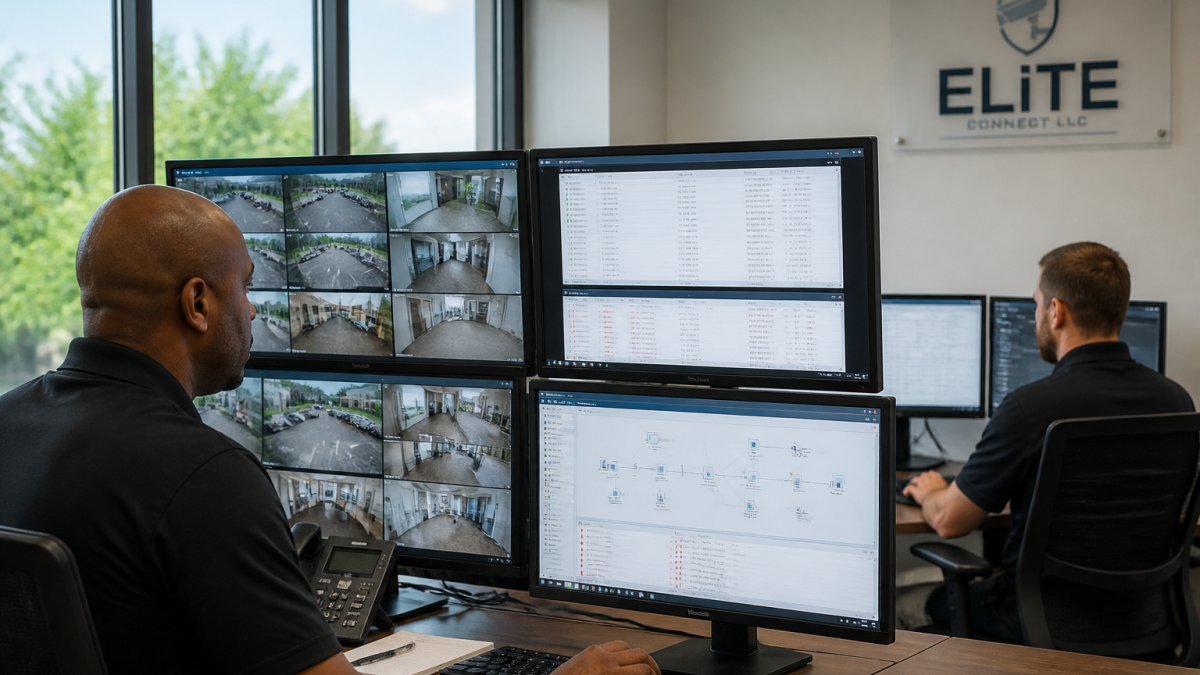
Video Surveillance and CCTV Systems
Video surveillance and CCTV systems have evolved far beyond simple recording, generating video feeds, metadata, event logs, and behavioral analytics. Integrated with your IT infrastructure, this data becomes actionable intelligence rather than archived footage nobody reviews.
The real value emerges when video integrates with access control: someone swipes a card and the nearest camera records; a person lingers in a restricted area and the system logs both the violation and video evidence. Your team responds to flagged events instead of watching hours of footage. Video surveillance and CCTV installation services connect directly to your network, enabling remote viewing, automated alerts, and broader security integration.
Intrusion Detection and Fire Alarm Systems
Intrusion detection systems monitor for unauthorized entry attempts, while fire alarm systems detect heat, smoke, and other life-safety hazards. Integrated, both alerts flow to the same command center, triggering coordinated response protocols.
Alarm Systems designed for integration communicate directly with your IT infrastructure, logging events with precise timestamps and context. A forced door triggers an alarm plus automated video capture, access log pull, and monitoring notification; fire detection alerts on-site personnel and, where required, emergency services with full documentation.
Visitor Management and Credential Control
Visitor management ties physical presence to authorization. Access control systems in an integrated environment don't just control doors, they create a complete audit trail of who accessed what, when, and whether the access was authorized. A contractor receives temporary credentials for specific areas during specific hours, and that event logs into your access control system; unauthorized entry gets flagged and expired credentials won't unlock the door.
Access-Control in an integrated environment don't just control doors, they create a complete audit trail of who accessed what, when, and whether the access was authorized. This becomes critical for compliance, incident investigation, and operational oversight.
IT and Physical Security Integration: Breaking Down Silos
The core problem is architectural: physical security and IT systems evolved separately, with access control on a proprietary network, video on its own platform, and IT infrastructure on something else entirely.
Breaking down silos means building an architecture where these systems share data, trigger coordinated responses, and report to a unified monitoring platform.
Network layer and segmentation. Physical security devices should not sit on the same flat network as employee laptops and business servers.
Identity layer. The identity provider is the hinge between IT and physical security.
Event pipeline. Integration is mostly about events.
Data layer: on-premises versus cloud. Video and access logs can live on-premises, in a private cloud, or hybrid.
The global integration security services market was valued at $17.9 billion in 2026 and is projected to reach $46.1 billion by 2033, according to Persistence Market Research's market forecast, reflecting the industry's recognition that siloed approaches no longer work. Organizations are actively consolidating vendors and investing in platforms that connect previously separate systems.
Integration demands more than software.
Access Control and Video Surveillance Integration for Real-Time Response
When access control and video surveillance operate independently, your response is reactive: you discover a problem after the fact, then hunt for footage. Integrated, your response becomes proactive and coordinated.
Here's how integration changes the response cycle: an employee's access card is used at a door where it shouldn't be active. The access control system flags the violation, triggers the nearest camera to record, and alerts your monitoring team.
Without integration, the access control system logs the event but triggers no alert.
Integration also enables context-aware responses: multiple access violations in the same area within a short timeframe can escalate the alert level, trigger additional camera coverage, and notify security personnel with higher urgency.
Network Security for Physical Security Systems
This is where most organizations stumble: they treat physical security devices as separate from their IT security posture.
Managed IT and MSP services that integrate with physical security systems must address four layers: current firmware with security patches, a segmented and monitored network, encryption of video feeds, access logs, and event data in transit and at rest, and restricted access with strong authentication.
Those four layers are the right frame, but the difference between a policy and a defensible posture is in the mechanisms. Here is what a practical hardening program looks like.
Device hardening and configuration baseline. Change default credentials on every camera, panel, and alarm controller before it touches the network.
Patching cadence. Security-device firmware lags corporate patching by months unless deliberately scheduled.
Encryption and data protection. Require TLS for administrative and video streams where supported, and encrypt recorded video and access-log databases at rest.
Credential and vendor-access management. Give each administrator a named account with multi-factor authentication; shared local admin accounts are a common audit finding.
Monitoring and incident response. Feed security-device logs and network flow data into the same monitoring stack used for corporate IT so anomalies such as a camera reaching an unknown external address or a panel rebooting unexpectedly are visible. Managed IT services that monitor physical security devices alongside corporate infrastructure ensure these systems receive the same patching, alerting, and incident response as core business systems.
The integration of IT services with physical security means your IT team monitors these systems with the same rigor as core business infrastructure: patches deployed promptly, traffic analyzed for anomalies, access logged and audited, backups maintained. Make that measurable with a service-level agreement naming uptime targets for cameras and access panels, patching windows for critical advisories, incident response times, and a defined resolution process, so buyers can compare providers on outcomes rather than adjectives.
A practical hardening program for physical security devices addresses four essential layers.
| Layer | Focus Area | Key Action |
|---|---|---|
| Device hardening | Configuration baseline | Change defaults, disable unused services, inventory all devices |
| Patching cadence | Firmware updates | Review advisories monthly, define critical-fix window |
| Encryption | Data protection | Require TLS for streams, encrypt video and logs at rest |
| Access management | Credentials and vendor support | Named accounts with MFA, time-bound vendor sessions via jump host |
Why Single-Source Accountability Matters
When you contract with separate vendors for access control, video surveillance, alarms, and IT services, accountability fragments.
Single-source accountability means one contractor assumes responsibility for the entire integrated system, installation, configuration, testing, documentation, and ongoing maintenance. When something fails, there's no finger-pointing between vendors.
This matters operationally and legally. For compliance, whether government contractor requirements, industry standards, or internal governance, you need clear documentation of what your security systems do, how they're configured, and whether they function as designed.
It also matters for incident response. With multiple vendors, you're assembling data from sources with different formats, timestamps, and retention policies; with a single vendor managing the integrated system, the data is coherent and complete.
Building Your Integrated Security Plan
Developing an integrated IT and security services plan requires assessment, defined objectives, integrated architecture design, documented implementation, and ongoing management.
Next, define your objectives, physical access control, theft prevention, compliance documentation, or emergency response. Different objectives drive different architectural decisions; a retail environment needs different integration than a government contractor facility.
Design your integrated architecture with your IT infrastructure as the foundation. Book a free consultation to discuss your specific security needs and develop an integrated plan tailored to your property or facility.
[Consult & proposal) to discuss your specific security needs and develop an integrated plan tailored to your property or facility.
Implementation matters as much as design: devices positioned correctly, connectivity optimized, and all systems tested before handoff.
Frequently Asked Questions
What are integrated IT and security services?
Integrated IT and security services combine physical security systems (cameras, alarms, access control), IT infrastructure (networking, data cabling, Wi-Fi), and managed IT support under one provider or coordinated team. Rather than managing separate vendors for each function, integrated services connect these systems so they share data, respond to threats together, and operate from a single management platform. This approach reduces response time, eliminates finger-pointing between vendors, and improves overall situational awareness.
How do IT services and physical security systems work together?
IT services provide the network backbone, security protocols, and monitoring tools that physical security systems depend on. Physical security devices like cameras, access control readers, and alarm sensors generate event data that flows through the IT network to a centralized platform. IT teams manage the cabling infrastructure, cybersecurity, system uptime, and remote access that allow security personnel to monitor and respond from anywhere. When integrated, a breach at one layer, such as a network vulnerability or a door access anomaly, triggers alerts across both IT and security operations simultaneously.
What should businesses look for in an integrated security provider?
Look for a provider with documented expertise in both physical security and IT infrastructure, not just one or the other. Verify they offer comprehensive documentation including test results and as-builts, not just installation. Ask about their response protocols when systems fail, who is accountable? Confirm they understand your compliance requirements (NDAA compliance for government contractors, for example). Request references from similar-sized properties or businesses, and check whether they provide proactive monitoring and maintenance, not just reactive repairs. Transparency about pricing, scope, and accountability is essential.
How can businesses protect connected security devices from cyber threats?
Connected security devices are network endpoints and must be treated as part of your IT security posture. Ensure your provider implements network segmentation to isolate security devices from general business traffic. Require regular firmware updates and patch management for all cameras, access readers, and sensors. Deploy intrusion detection on security networks to identify unusual activity. Use strong authentication for access to security management platforms. Conduct regular security assessments of the integrated system. A provider offering managed IT services should include cybersecurity oversight of your physical security infrastructure as part of their service.
Integrated IT and security services aren't a luxury for large enterprises anymore, they're essential infrastructure for any organization serious about security. The complexity of managing separate systems, the risks of uncoordinated response, and the compliance demands of modern business make integration the practical choice. Your security posture depends on visibility, coordination, and accountability. Integration delivers all three.