
Table of Contents
- What a Commercial Security Infrastructure Audit Includes
- Security Infrastructure Assessment: Evaluating Your Current Systems
- CCTV System Audit Checklist: What Auditors Examine
- How to Prepare for a Commercial Security System Audit
- Security Audit Report Template: What Deliverables to Expect
- Scoping and Booking Your Audit: Pricing, Timeline, and Provider Selection
- Implementation Timeline and Remediation
- Frequently Asked Questions
Last Updated: October 18, 2026
What a Commercial Security Infrastructure Audit Includes
When you book commercial security audit services, the assessment examines your physical security systems, access controls, surveillance technology, and IT infrastructure to identify vulnerabilities, compliance gaps, and operational inefficiencies.
The scope of a security audit typically covers your current security posture across multiple dimensions. Your auditor will assess physical barriers, camera placement and coverage, alarm system responsiveness, network architecture, data protection protocols, and whether your systems meet regulatory requirements for your industry.
What makes this process valuable is that most organizations operate with fragmented security systems installed over years by different vendors. A coordinated audit reveals gaps in coverage, redundancies, and integration failures that create actual security risks.
The audit process itself typically takes 2-4 weeks from initial scope definition through final report delivery.
Security Infrastructure Assessment: Evaluating Your Current Systems
Your current systems likely evolved incrementally. A new camera system was added here, access control upgraded there, cabling installed for a different project. The security infrastructure assessment examines this reality and maps it against what actually protects your assets.
An effective assessment evaluates several key dimensions. First, physical security infrastructure, doors, locks, barriers, lighting, and how they're integrated with electronic systems. Second, surveillance systems and their actual coverage. Third, access control mechanisms and whether they're properly configured. Fourth, network security and whether your IT infrastructure can support modern security systems without creating vulnerabilities. Fifth, compliance requirements specific to your industry or tenant base.
Physical and Cyber Convergence
This is where most audits fall short. Your physical security systems now depend on IT infrastructure, network connectivity, power management, data storage, and authentication systems. A vulnerability in your network can compromise your cameras. A misconfigured firewall can expose your access control system.
When we evaluate your security infrastructure, we assess this convergence directly. We examine whether your structured cabling supports modern security systems, whether your network architecture isolates security systems appropriately, whether your managed IT services include proactive monitoring of security infrastructure, and whether your data protection practices meet both physical security and cybersecurity standards.
The audit report should explicitly address this integration. It should identify where physical and cyber systems depend on each other and where gaps exist. Many organizations discover during an audit that they've invested heavily in physical security but created new vulnerabilities through poor IT infrastructure decisions.
CCTV System Audit Checklist: What Auditors Examine
When auditors conduct a CCTV system audit checklist, they're evaluating far more than whether cameras exist. They're assessing whether your surveillance infrastructure actually protects your assets and meets your operational needs.
The checklist covers camera placement and coverage, are there blind spots? Do overlapping fields of view create redundancy for critical areas?
Storage and retention are critical. How much video do you retain? Is it sufficient for incident investigation? Are your storage systems properly backed up? Is access to recorded footage properly controlled?
Network configuration for CCTV systems receives detailed attention. Are cameras isolated on a separate network segment, or do they share bandwidth with critical business systems? Is video traffic encrypted? Are camera credentials properly managed?
Finally, auditors evaluate whether your CCTV systems integrate with other security infrastructure. Do alarms trigger recording? Can access control events correlate with video footage?
How to Prepare for a Commercial Security System Audit
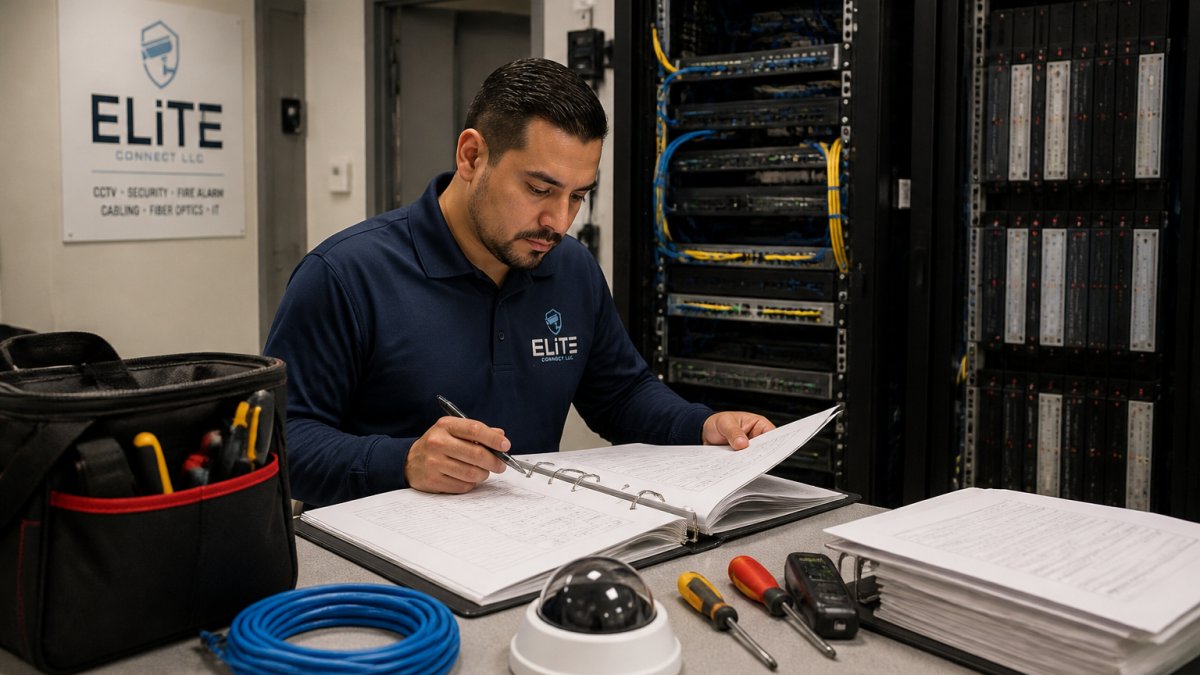
Preparation determines audit efficiency and the quality of your final security audit report template. Start by gathering documentation of your existing systems, system diagrams, installation records, maintenance logs, and any previous audit reports. Compile a list of all security infrastructure: camera models and locations, alarm system details, access control hardware and software, network topology, and IT infrastructure relevant to security systems. Integrating these physical assets with digital frameworks often necessitates a comprehensive infrastructure modernization audit to ensure that legacy components align with current operational standards.
Gather Documentation and Access Records
Documentation is the foundation of a thorough audit. Auditors need to understand what you have, when it was installed, how it's been maintained, and what problems you've experienced. Incomplete documentation often means auditors must spend time rediscovering systems, which extends the timeline and increases costs.
Compile your structured cabling documentation, network diagrams, cable runs, termination points. Gather your access control records, who has access to which areas, how long credentials are valid, audit logs of access events. Collect maintenance records for all systems. If you've experienced security incidents, include incident reports and how they were resolved. Document any compliance requirements specific to your industry, your tenant agreements, or regulatory obligations.
Schedule Site Access and System Downtime
Auditors need physical access to your property and to your systems. Coordinate with your team to establish times when auditors can access server rooms, equipment closets, and various areas of your facility. Some assessments require testing systems, which may briefly interrupt service. Schedule this downtime during periods that minimize operational impact.
Ensure that system administrators, facility managers, and security personnel are available during the audit. They can provide context about system configurations, explain why certain decisions were made, and help auditors understand your operational constraints and priorities.
Security Audit Report Template: What Deliverables to Expect
Your final security audit report template should be comprehensive and actionable. The report typically opens with an executive summary that outlines your current security posture, key findings, and high-level recommendations.
The body of the report documents your security infrastructure in detail. It describes what was assessed, how it was evaluated, and what was found. It should include photographs of physical security infrastructure, network diagrams, access control configurations, and CCTV coverage maps.
The remediation section is where the report becomes actionable. It recommends specific improvements with estimated costs and implementation timelines. It should explain why each recommendation matters, what risk it mitigates, what capability it enables, or what compliance requirement it addresses.
A quality report from Elite Connect LLC includes not just findings and recommendations but test results, as-built documentation, and evidence of current configurations.
Scoping and Booking Your Audit: Pricing, Timeline, and Provider Selection
When you book commercial security audit services, you need clarity about what you're actually purchasing. Audits vary dramatically in scope, depth, and cost depending on your facility size, system complexity, and compliance requirements.
Define Your Audit Scope
Start by identifying what you need assessed. Are you auditing your entire facility or specific areas? Are you evaluating only physical security or the full integration of physical and cyber systems? Do you need compliance assessment against specific standards? Are you planning a major infrastructure upgrade and need guidance on design?
Your scope should address your actual business drivers. If you're concerned about access control vulnerabilities, the audit should emphasize that area. If you're integrating new systems and need to understand how they affect your existing infrastructure, the scope should prioritize integration assessment. If you're subject to regulatory requirements, the scope must explicitly address compliance gaps.
A well-defined scope prevents scope creep and ensures you're not paying for assessment of areas that don't matter to your operation. It also gives auditors clear parameters for their work, which improves efficiency and reduces timeline uncertainty.
Understand Audit Pricing and Procurement
Audit pricing depends on facility size, system complexity, and scope depth. A small facility with basic security systems costs less to audit than a large complex with integrated physical security, access control, CCTV, fire alarm systems, structured cabling, and managed IT.
When you request proposals from potential auditors, ask what's included in their pricing. Does it cover site visits, documentation review, control testing, report preparation, and remediation recommendations? Are there additional costs for specialized assessments like network security evaluation or compliance certification? What's the timeline and what happens if you need expedited delivery?
Pricing for a commercial security infrastructure audit typically reflects the expertise required. Auditors with experience in your industry, with relevant certifications, and with deep knowledge of security systems and compliance standards will command higher rates, and deliver more valuable assessments. The cheapest audit isn't necessarily the best value if it misses critical vulnerabilities or fails to address your compliance requirements.
Verify Compliance and Credentials
Before booking an audit, verify that your auditor has relevant credentials and experience. Ask about certifications, do they hold security industry certifications? Have they conducted audits in your industry? Can they reference similar projects?
Ask about their approach to compliance assessment. If your industry has specific security requirements, your auditor should understand them. If you need NDAA-compliant infrastructure documentation, your auditor should have experience with government compliance requirements. If you're subject to HIPAA, PCI, or SOC 2 requirements, your auditor should understand what those standards require of your security infrastructure.
Ask about their documentation practices. Will they provide test results showing what they verified? Will they deliver as-built documentation showing your actual configurations? Will they provide evidence of their assessment methodology?
Implementation Timeline and Remediation
After your audit, you'll have a roadmap for improving your security infrastructure. Implementation timelines depend on the scope of recommended changes and your operational constraints.
Critical vulnerabilities, those that pose immediate security risks, should be remediated quickly, often within 30-60 days. High-priority improvements that address significant compliance gaps or operational inefficiencies typically follow within 60-180 days. Medium-priority enhancements can be phased over 6-12 months.
Remediation often requires coordinating multiple trades. Access control upgrades may require electrical work and network infrastructure changes. CCTV system improvements may involve structured cabling installation and network configuration.
This is where having a single point of accountability matters.
Your security infrastructure is too critical to leave gaps. We'll assess your current systems, identify gaps, and help you build security infrastructure that actually works. Contact Elite Connect LLC today for a consultation and proposal that addresses your specific security needs.
Frequently Asked Questions
What does a commercial security infrastructure audit include?
A commercial security infrastructure audit examines your entire security posture, including CCTV systems, access control, alarm systems, network security, data cabling, and IT infrastructure. Auditors assess control frameworks, identify vulnerabilities, evaluate compliance with regulatory requirements, collect evidence, and document findings. The audit scope depends on your business assets, facility size, and industry-specific compliance needs. A comprehensive audit typically covers physical security systems, cybersecurity controls, risk analysis, and gap analysis to measure your current security assurance level.
How do I prepare for a commercial security infrastructure audit?
Gather all system documentation, including as-builts, maintenance records, and test results for existing infrastructure. Create a list of business assets and digital assets requiring protection. Identify key personnel who can provide system access and answer technical questions. Schedule the audit during a time that minimizes disruption to operations. Ensure the auditor has access to all relevant areas, including server rooms, network closets, and security control centers. Prepare a list of known issues or concerns you want the auditor to address during the assessment.
What should an auditor check in a CCTV system audit checklist?
A CCTV system audit checklist should verify camera placement and coverage, image quality and resolution, recording storage capacity and retention policies, backup systems, access control to recorded footage, network connectivity and bandwidth, power supply redundancy, and maintenance schedules. Auditors evaluate whether cameras adequately protect critical business assets, identify blind spots, assess threat mitigation, and document control testing results. The checklist should also confirm compliance with data protection regulations and verify that the system integrates properly with access control and alarm systems for comprehensive security architecture.
How much does a commercial security infrastructure audit cost?
Audit pricing depends on facility size, system complexity, scope of assessment, and whether you need NDAA compliance verification or specialized testing. A small office audit may cost less than a multi-building complex assessment. Pricing factors include the number of systems to evaluate, documentation requirements, travel time, and report depth. Rather than estimating costs, contact a qualified security consultant for a detailed proposal. Transparent providers will itemize costs and explain what's included before you commit, ensuring you understand the investment required for a thorough security infrastructure assessment.
What deliverables should I expect after a security infrastructure audit?
Expect a comprehensive security audit report template that includes audit findings, risk prioritization, gap analysis, and remediation recommendations. Deliverables should include detailed documentation of all systems evaluated, test results, as-builts showing current infrastructure, evidence collection summaries, and corrective action plans. The report should identify vulnerabilities, assess compliance gaps, and provide a clear implementation timeline for security improvements. Professional auditors also provide recommendations for continuous monitoring and risk mitigation strategies. Verify that your auditor commits to delivering complete documentation before you book the audit.