
Table of Contents
- What NDAA-Compliant Security System Installers Deliver
- NDAA Section 889 Compliance: What Installers Must Verify
- NDAA-Compliant Security Cameras and Equipment Selection
- Security System Installation Documentation: Your Compliance Record
- Security Camera Cabling Alternatives for Compliant Systems
- How to Verify Installer Qualifications and Compliance Credentials
- Residential and Commercial Security Installation Services
- Conclusion
- Frequently Asked Questions
Last Updated: October 16, 2026
What NDAA-Compliant Security System Installers Deliver
NDAA compliant security system installers bring specialized expertise to organizations that must meet federal procurement standards. Unlike general security contractors, these installers understand the specific equipment restrictions, documentation requirements, and compliance verification processes mandated by the National Defense Authorization Act Section 889.
The core mission of NDAA compliant security system installers is straightforward: deliver security infrastructure that passes federal scrutiny. This means selecting cameras, recorders, and networking equipment from manufacturers verified to meet compliance standards. It means maintaining detailed installation records, test results, and as-built documentation that prove compliance at every stage.
At Elite Connect LLC, we've built our entire operation around this principle. We integrate security camera installation, alarm systems, access control, and structured cabling under one contractor. This single-point-of-accountability approach eliminates the coordination gaps that create compliance blind spots.
What separates compliant installers from standard security contractors is documentation discipline. Federal procurement officers don't just want working cameras. They want test results proving those cameras function. They want as-built drawings showing exactly what was installed where.
NDAA Section 889 Compliance: What Installers Must Verify
NDAA Section 889 compliance is the federal requirement prohibiting federal agencies and their contractors from purchasing or using telecommunications equipment manufactured by certain Chinese companies. The restriction applies directly to security cameras, recorders, networking equipment, and cabling used in federal projects or facilities.
The practical impact: your installer must verify that every piece of equipment comes from an approved manufacturer. This isn't optional documentation, federal procurement officers audit it. An installer who sources a camera from an unapproved vendor, even accidentally, can trigger contract rejection and force complete system replacement.
What installers must verify includes:
- Camera manufacturers: Only approved brands like Axis Communications, Avigilon (Motorola Solutions), AV Costar (formerly Arecont Vision), and Hanwha Vision qualify. Chinese-manufactured equipment is prohibited regardless of where it's sold.
- Recorder and NVR systems: Storage devices must come from compliant manufacturers. Many budget recorders fail this test.
- Networking equipment: Switches, routers, and wireless access points must also meet compliance standards.
- Cabling and infrastructure: Even low-voltage cabling must trace back to compliant manufacturers.
A qualified NDAA compliant security system installer maintains an active list of approved equipment and regularly updates it as manufacturer certifications change. They don't guess. They verify each component against current federal lists before ordering.
NDAA-Compliant Security Cameras and Equipment Selection
Choosing compliant security cameras requires understanding both compliance status and operational requirements. The cameras must work for your specific use case while meeting federal procurement standards.
NDAA-compliant security cameras from manufacturers like Axis Communications vary in cost depending on resolution, features, and installation complexity. Higher-end models with advanced analytics or specialized optics cost more. Budget options exist, but they often lack the documentation trail that federal projects require.
The selection process works differently than standard camera purchasing. Instead of browsing product catalogs, compliant installers start with the approved manufacturer list, then identify which models meet your specific needs.
Elite Connect LLC specifies equipment in itemized proposals before installation begins. This means you see exactly which camera model, which recorder, which cabling category, and which networking equipment will be installed. No surprises. No substitutions.
Common compliant camera options include:
- Axis Communications models: Network cameras with strong compliance documentation and broad feature range
- Avigilon thermal and standard models: Part of Motorola Solutions, offering enterprise-grade reliability
- AV Costar outdoor cameras: American-manufactured alternative with full compliance verification
- Hanwha Vision models: TAA-compliant options suitable for small to medium installations
The equipment you select determines your total cost of ownership. A cheaper camera that requires frequent maintenance or early replacement costs more over five years than a reliable compliant model.
Security System Installation Documentation: Your Compliance Record
Documentation is not paperwork. It's proof. Federal procurement officers reviewing your system don't take your installer's word that everything works. They want evidence.
NDAA compliant security system installers deliver three critical documents:
1. Test Results Every camera, recorder, and network connection gets tested after installation. Tests verify that cameras transmit video, recordings save properly, and network connectivity is stable. Results are documented with dates, technician names, and specific findings. If a test fails, it's fixed and re-tested. Federal auditors review these results to confirm the system actually works.
2. As-Built Drawings As-built documentation shows exactly what was installed, where it was installed, and how it connects. This includes camera locations, cabling routes, equipment rack layouts, and network topology. When federal inspectors arrive, they compare the as-builts to what's actually in place. Discrepancies trigger compliance failures.
3. Equipment Certification Records Every piece of equipment, camera, recorder, switch, cable, comes with manufacturer documentation proving compliance status. Installers compile these into a certification package. Federal procurement officers can trace every component back to the manufacturer and verify approval status.
Many security installers skip this documentation or treat it as optional. Compliant installers understand it's mandatory. The documentation is what makes the system auditable. Without it, you have equipment that might work, but you have no proof it meets federal standards.
Security Camera Cabling Alternatives for Compliant Systems
Cabling is often overlooked in compliance discussions, but it's critical. The cable running from your camera to your recorder must come from an approved manufacturer. Budget cabling from unapproved sources can trigger compliance failures even if the cameras and recorder are compliant.
NDAA compliant security system installers typically use:
- Structured cabling systems: Category 6A or higher from compliant manufacturers, often bundled with data cabling for integrated low-voltage infrastructure
- Fiber optic alternatives: For longer runs or environments with electromagnetic interference, fiber provides compliance flexibility and superior performance
- Shielded twisted pair: Standard cabling option when properly sourced from approved vendors
The choice depends on distance, environment, and integration requirements. An installer who understands all three options can design a system that meets compliance requirements while optimizing performance and cost.
Elite Connect LLC approaches cabling as part of integrated infrastructure. When we design your security system, we consider how camera cabling integrates with data cabling, Wi-Fi access points, and alarm system wiring. This integrated approach reduces installation complexity and ensures all components work together reliably.
Cabling alternatives matter because they affect:
- Installation timeline: Fiber provides better long-term reliability than copper.
- Future scalability: Structured cabling designed for growth can save money when you expand.
- Compliance documentation: Some cabling options have better manufacturer documentation trails
How to Verify Installer Qualifications and Compliance Credentials
Verifying an installer's qualifications protects you from compliance failures and ensures your system actually works. This requires checking specific credentials, not just reading marketing claims.
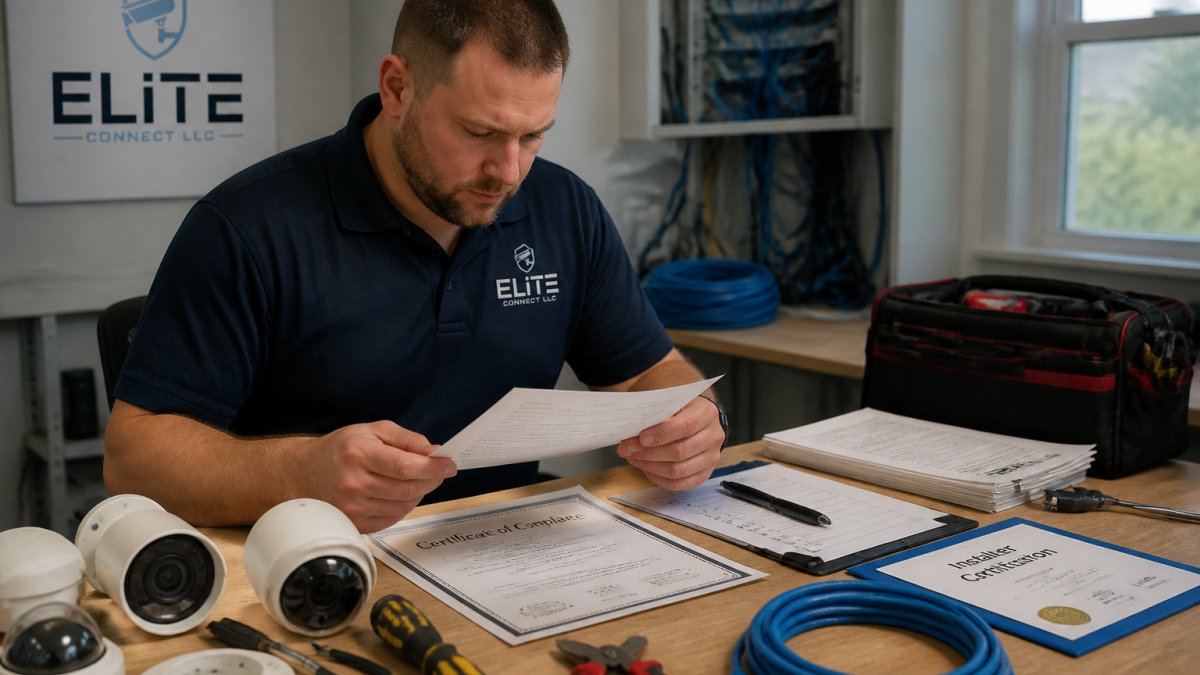
Start with licensing verification. NDAA compliant security system installers should hold:
- Electronic Security Services license: Required by most states for security system installation
- Fire alarm specialty certification: Needed when systems integrate with fire safety infrastructure
- Low-voltage contractor license: Demonstrates expertise in cabling and infrastructure
- Class A or equivalent contractor license: Shows general construction competency and bonding
You can verify these licenses through your state's licensing board. A legitimate installer provides license numbers upfront. If they're vague about credentials, that's a warning sign.
Next, ask for compliance project experience. How many NDAA compliant systems has this installer completed? Can they provide references from federal projects?
Request documentation of their compliance verification process. How do they confirm equipment is on approved lists? Do they maintain relationships with manufacturers for certification updates?
Elite Connect LLC provides Virginia Class A Contractor license #2705190126, Virginia DCJS #11-20830, and Fire alarm specialty certification. We maintain 5.0 ratings on Google and Thumbtack with 96 BuildZoom score.
Ask potential installers for their compliance documentation package. What will they deliver after installation? How detailed are their test results? Do they provide equipment certification records?
Residential and Commercial Security Installation Services
NDAA compliant security system installers serve both residential and commercial markets, though the compliance requirements and scale differ significantly.
Commercial security installations typically involve larger facilities with multiple camera locations, integrated alarm systems, access control, and networked infrastructure. A commercial property might have 20-50 cameras covering parking areas, entrances, and interior spaces. These systems require professional-grade equipment, redundant recording, and comprehensive documentation.
Residential security installations focus on home protection with smaller camera counts, simpler integration, and faster deployment. A residential system might include 4-8 cameras covering entry points and high-value areas.
The key difference isn't the equipment quality, both use compliant cameras and recorders. The difference is scale and documentation intensity. A commercial system requires detailed site surveys, professional installation crews, and extensive coordination with existing building systems.
Elite Connect LLC handles both markets. We've installed security systems for commercial properties, residential complexes, and individual homes requiring federal compliance. Our single-point-of-accountability model works at any scale because one contractor manages all nine trades, security cameras, alarm systems, access control, cabling, networking, and integration.
| Installation Type | Typical Camera Count | Timeline | Documentation Intensity | Best For |
|---|---|---|---|---|
| Residential | 4-8 cameras | 3-7 days | Standard compliance package | Individual homes, small properties |
| Small Commercial | 8-20 cameras | 1-3 weeks | Detailed site surveys, integration plans | Office buildings, retail locations |
| Large Commercial | 20-50+ cameras | 4-12 weeks | Comprehensive documentation, redundancy | Multi-location facilities, government buildings |
Conclusion
Finding NDAA compliant security system installers requires understanding what compliance actually means and verifying that your installer delivers it. It's not enough to buy compliant equipment. The installer must verify compliance, document it thoroughly, and maintain records that federal procurement officers can audit.
Elite Connect LLC delivers NDAA-compliant infrastructure with meticulous attention to detail. We provide itemized proposals specifying cable type, category, and rating. We deliver comprehensive documentation including test results and as-builts. We integrate nine distinct trades under one contractor, eliminating the coordination gaps that create compliance blind spots. Our Virginia Class A Contractor license, DCJS certification, and fire alarm specialty ensure we meet every regulatory requirement.
Get started with Elite Connect LLC and build security infrastructure that passes federal scrutiny and actually protects your facility.
Federal Acquisition Regulation Section 889 guidelines outline the specific equipment restrictions and procurement requirements for federal contracts. CISA guidance on supply chain security and equipment verification provides additional standards for identifying compliant manufacturers. Axis Communications NDAA compliance documentation demonstrates how leading manufacturers support compliance verification for installers and federal buyers.
Frequently Asked Questions
What does NDAA-compliant mean for security cameras and systems?
NDAA Section 889 compliance means security equipment and cameras are manufactured and sourced without prohibited Chinese components or technology. The National Defense Authorization Act restricts federal agencies and contractors from using equipment containing certain foreign-origin parts. For security systems, compliance requires verified equipment from approved manufacturers and installers who document the origin and components of every device. An NDAA-compliant security camera installer confirms that each camera, recorder, cabling component, and network device meets these federal standards and provides written verification.
How can I verify that a security camera is NDAA compliant?
Request the installer provide manufacturer certification, TAA (Trade Agreements Act) compliance documentation, and a bill of materials listing each component's origin. Verify the camera model directly with the manufacturer to confirm it appears on their NDAA-compliant product list. Ask the installer for test results and as-built documentation showing exactly what equipment was installed. A qualified NDAA-compliant security system installer will supply this documentation without hesitation and explain how each component meets compliance requirements. If an installer cannot provide written verification, the system is not compliant.
What documentation should an installer provide after a security system installation?
A compliant installer delivers comprehensive documentation including itemized proposals specifying cable type, category, and rating; test results for all cabling and network connections; as-built drawings showing system layout and equipment placement; manufacturer compliance certificates for cameras and recorders; and a system maintenance and support schedule. This documentation proves the installation meets code requirements, passes inspection, and maintains compliance over time. Without these records, you cannot verify compliance, cannot troubleshoot future issues, and cannot prove the system was installed correctly if problems arise.
Can an NDAA-compliant camera system use existing cabling?
Existing cabling can be used if it meets current fire alarm and electronic security codes and if the installer verifies its specifications and tests it for performance. However, older cabling may not support modern camera bandwidth requirements, may not be properly documented, or may contain components that do not meet NDAA standards. A qualified installer will evaluate existing cabling, test it, and recommend replacement if it does not meet compliance or performance standards. The decision depends on the cable's age, condition, documentation, and the specific cameras being installed.